ORNL-developed building efficiency software now available

Fonte (Source): Phys.org

Por (By): Bill Cabage

Acesse aqui a matéria em sua fonte.

ornldevelope

Automated calibration software for building efficiency studies, developed by Oak Ridge National Laboratory researchers Jibonananda Sanyal (left) and Joshua New, is now available as an open source code.

A set of automated calibration techniques for tuning residential and commercial building energy efficiency software models to match measured data is now available as an open source code. The Autotune code, developed at the Department of Energy’s Oak Ridge National Laboratory, is available on GitHub.

ORNL principal investigator Joshua New, in collaboration with a team of researchers, developed the automated calibration , which reduces the amount of time and expertise needed to optimize  parameters for cost and energy savings.

By cheaply producing calibrated building energy models, Autotune allows “no-touch” audits, optimal retrofits and other simulation-informed applications to be cost-effectively realized for buildings traditionally too small (below 50,000 ft2) to be serviced by industry.

“The methodology uses multi-parameter optimization techniques, in combination with big data mining-informed artificial intelligence agents, to automatically modify software inputs so simulation output matches measured data,” New, a researcher in ORNL’s Building Technologies Research and Integration Center, said.

“Instead of having a human change the knobs, so to speak, the Autotune methodology does that for you,” BTRIC researcher Jibonananda Sanyal said.

To develop their software, the team used DOE supercomputing and computational resources—including ORNL’s Titan supercomputer and the National Institute for Computational Sciences’ Nautilus system—to perform millions of EnergyPlus simulations for a range of standard building types with generated data totaling hundreds of terabytes. Titan resides in the ORNL Leadership Computing Facility, a DOE Office of Science User Facility.

By mining this data and trying many different calibration algorithms, the researchers were able to identify techniques and evolutionary computations that can quickly evolve a building to match measured data. On Titan, the team has been able to run annual energy simulations for more than half a million buildings and write 45 terabytes of simulation output to disk in less than one hour using over a third of Titan’s nearly 300,000 CPU cores in parallel.

The code made available contains: (1) a backend that performs the evolutionary calibration, (2) a web service that allows scripting for calibrating large numbers of buildings and (3) a front end website which allows users to interact with the software

 Explore further: Titan is also a green powerhouse

More information: Autotune is available via Github, github.com/ORNL-BTRIC/Autotune. For more information, contact Joshua New, (865) 241-8783, newjr@ornl.gov.

Read more at: http://phys.org/news/2015-09-ornl-developed-efficiency-software.html#jCp

Publicado em Eficiência Energética, Mundo, Sustentabilidade | Com a tag , , , , , | Deixe um comentário

Longo caminho para a eficiência

Fonte: Revista Construção Mercado

Acesse aqui a reportagem na íntegra.

Diferenciais de sustentabilidade reduzem o custo de operação e atraem clientes qualificados para galpões industriais e logísticos, mas segmento ainda resiste em fazer investimentos

Cada vez mais importante nos prédios comerciais e residenciais, a sustentabilidade ainda não mobiliza fortemente o segmento industrial e logístico. Há resistência dos empresários a novos modelos de produtos, na opinião de profissionais do mercado, e os imóveis certificados por selos verdes ainda ficam restritos a grandes projetos. Na verdade, os desafios de qualidade são os maiores para o segmento na atualidade.

Segundo o vice-presidente do Sindicato da Indústria Civil no Estado do Paraná (Sinduscon-PR), Euclésio Finatti, ainda existe uma barreira cultural na maior parte dos incorporadores para que mais investimentos em sustentabilidade ocorram. Ele diz que o empresário teme ter um retorno que não compense os possíveis custos adicionais.

Finatti revela que as intervenções com foco em sustentabilidade custam de 2% a 5% do valor total do empreendimento, incluindo a certificação.

“Em cinco anos, em média, esse investimento se apaga e volta para a incorporadora. Em alguns casos, o custo da obra até diminui quando são escolhidos materiais mais adequados”, conta Finatti.

O investimento, segundo ele, é compensado pelo valor que pode ser agregado na locação do imóvel e pela rapidez com que o empreendimento é ocupado. “Os imóveis são locados 30% mais rapidamente do que as edificações comuns.”

As adaptações destinadas à economia de energia e água estão entre os principais atrativos dos galpões sustentáveis. Destacam-se nesse sentido o uso de dispositivos sanitários de baixo consumo de água, o aproveitamento da chuva para abastecimento das bacias e mictórios, a instalação de sistemas de iluminação eficiente, com uso de LED e dimerização em consonância com a arquitetura e o paisagismo – que podem priorizar maior aproveitamento da iluminação natural, tratamento térmico das fachadas e coberturas e uso de espécies vegetais nativas.

Clique no link abaixo e leia a reportagem na íntegra

Revista Construção Mercado – Agosto 2015.pdf

Publicado em Eficiência Energética, Sustentabilidade | Com a tag , , | Deixe um comentário

More Durable Concrete May be Possible with Sewage Sludge Mixture

Fonte (Source): Engineering.com

Por (By): Kagan Pittman

Acesse aqui a matéria em sua fonte.

Researchers from Malaysia’s Universiti Teknologi MARA’s Faculty of Engineering are investigating the possible use of sludge from sewage wastewater as a material to create concrete.

To see if the idea was viable, the team set out to produce domestic waste sludge powder (DWSP) by burning sun-dried sludge cake in a ferro-cement furnace over 72 hours to remove as much moisture as possible. They then ground and sieved the cake to make the sludge powder.

Process involved in the production of Domestic Waste Sludge Powder (DWSP). Image courtesy Faculty of Civil Engineering, Universiti Teknologi MARA, Shah Alam, Selangor, Malaysia.

Process involved in the production of Domestic Waste Sludge Powder (DWSP). Image courtesy Faculty of Civil Engineering, Universiti Teknologi MARA, Shah Alam, Selangor, Malaysia.

Different proportions of DWSP (three, five, seven, 10 and 15 percent) were mixed with Grades 30, 40 and 50 cement to produce a range of concrete samples. These were then compared with normal samples of concrete in compressive strength, water absorption, permeability and rapid chloride ion penetration.

Results showed DWSP concrete had lower compressive strength, and higher water absorption and permeability with greater concentrations of DWSP.

Grade 40 concrete with seven percent DWSP was the exception , displaying greater compressive strength and lower water absorption and permeability, creating a more durable concrete.

Resistance to chloride permeability increased for concretes with 15 percent DWSP.

“Overall, there is potential for using DWSP as a partial cement replacement. However, more detailed research should be conducted to yield methods for producing quality powder,” the researchers concluded in their study.

From a civil engineering perspective this idea might stink at first, but Malaysia’s construction sector has recently been looking for economic and ecological replacement materials for cement. The sludge powder may not completely replace cement, but does offer an opportunity to use a little less.

The solution also “kills two birds with one stone.” The country’s wastewater plants are experiencing a growing issue with disposing the sludge produced from sewage water treatment.

Studies indicate that the volume of sludge is expected to rise and disposal options are limited due to environmental regulations, which include a ban on burying sludge in soil due to its high heavy metal content. So why not put it to a more practical use?

The study was published in the Pertanika Journal of Science and Technology.

Publicado em Artigos Diversos, Artigos Tecnicos, Mundo | Com a tag , , , , , , | Deixe um comentário

Eficiência energética na indústria estará em evidência na Mercopar

Fonte: JorNow

Acesse aqui a matéria em sua fonte.

O consumo de energia elétrica representa um dos principais custos do setor industrial, independente do porte das empresas. No Brasil, cerca de 34% da energia gerada é consumida pela indústria, o que impacta diretamente nos custos, fator potencializado pelos recentes aumentos de tarifas. Diante desse quadro, a Mercopar dedicará atenção especial a este tema durante a feira que acontece de 6 a 9 de outubro, em Caxias do Sul, reunindo expositores das áreas de automação industrial, borracha, eletroeletrônico, energia e meio ambiente, metalmecânico, movimentação e armazenagem de materiais, plástico e serviços industriais.

De acordo com a gestora estadual das soluções de sustentabilidade da Gerência de Inovação e Tecnologia do SEBRAE/RS, Cristina Correia, a Mercopar contará com um espaço onde serão disponibilizadas assessorias individuais tanto para os expositores quanto para os visitantes. Além disso, também será possível realizar avaliações gratuitas para identificar oportunidades de melhorias na gestão de energia da empresa, além de verificar o potencial para a implantação de sistemas fotovoltaico, termosolar e eólico. “Serão realizados seis tipos de avaliações on-line: gestão de energia, equipamentos, potencial fotovoltaico, potencial eólico e potencial de certificação de edificações”, explica Cristina Correia.

BANCADAS DEMONSTRATIVAS – Neste mesmo espaço, disponibilizado por meio de uma parceria entre o SEBRAE/RS e o SENAI, haverá, ainda, bancadas demonstrativas e consultores que irão explicar o funcionamento e as vantagens da adoção de práticas para melhorar a eficiência da energia nas indústrias. São elas:

Bancada demonstrativa de Sistemas Fotovoltaico – Apresentação de placas fotovoltaicas, simulação de geração de energia, orientação sobre custo-benefício de adoção do sistema;

Bancada de motores – simula consumo energético de motores rebobinados, comparados com motores novos, orientação sobre dimensionamento e eficiência de motores e seus impactos no consumo de energia;

Painel de Iluminação – Com auxílio de um luxímetro, o consultor fará comparação de intensidade luminosa e consumo de energia dos diferentes tipos de lâmpadas;

Telão para apresentação da ferramenta de simulação – Apresentação de ferramenta de simulação que auxilia a criação de modelos digitais de sistemas logísticos e de produção, para que seja possível explorar as características dos sistemas e otimizar seu desempenho. A otimização de desempenho permite a redução do consumo de energia;

Câmera Termográfica – A termografia como método preventivo na Indústria permite: detectar maus apertos ou corrosões nos contatos elétricos; análise de quadros elétricos; detecção de maus contatos, relés defeituosos, ventiladores defeituosos, detecção de problemas relacionados com sobrecargas e qualidade de energia, detecção de problemas elétricos em motores.

A Mercopar, que acontece no Centro de Feiras e Eventos da Festa da Uva, é o mais importante evento na área de inovação industrial e subcontratação da América Latina. A realização é do Serviço de Apoio às Micro e Pequenas Empresas do Rio Grande do Sul (SEBRAE/RS) e da Hannover Fairs Sulamerica, empresa do Grupo Deutsche Messe AG. O cadastro para visitação, assim como mais informações, podem ser obtidas pelo site www.mercopar.com.br.

Publicado em Eficiência Energética, Sustentabilidade | Com a tag , , , | Deixe um comentário

Em ano em que a coisa está ESQUISITA…

Fonte: Revista INFRA

Acesse aqui a matéria em sua fonte.

…Estar face to face com nossos clientes é fundamental

Para liderar em tempos difíceis, onde já sabemos que a coisa vai ficar ainda mais esquisita, precisamos ter a capacidade de articular e fazer perguntas certas. Uma delas é o que a crise traz de bom? Nos obriga a criar formas inteligentes de trabalhar no médio e longo prazo. Outra pergunta: Será que existe uma luz no final do túnel? A questão a ser respondida deve ser: eu sei qual é o tamanho do meu túnel? Se ainda não sabe, que tal fazer um plano de voo.

Como fazer um plano de voo? Inicie conversando com seus clientes, perguntando o que é possível ou não fazer naquele momento. De que forma podem juntos atuar nos pontos que ambos podem controlar. Além disso é preciso ter resiliência e foco nas estratégias traçadas, comunicar a equipe sobre o real momento da empresa. A honestidade, a transparência e a ética são essenciais para que seus parceiros queiram continuar trabalhando juntos com você, para que todos possam cumprir seus objetivos. Afinal, seu cliente precisa do seu produto/serviço para que o negócio dele continue girando.

Onde está o seu cliente? Como você, o seu cliente também está em busca de alternativas, de soluções. No segmento de facilities, muitos clientes estarão no 9º. Infra Rio, um local onde estão indo para buscar mais conhecimento e se relacionar com outros players do segmento, para que juntos possam ter insights diferentes. Afinal, falou em reduzir custos, a área de FM é certamente a primeira a ser chamada para renegociar os contratos de serviços. Agora a pergunta: Será que estamos fazendo esta redução de forma correta?

Nossos palestrantes estarão conversando conosco no dia 23 de setembro no 9º. INFRA Rio. Participe, já somos mais de 200 inscritos. Acesse www.eventosinfra.com.br e saiba mais!

Publicado em Artigos Diversos, Brasil, Facility Management | Com a tag , , , | Deixe um comentário

SBCS realizará Simpósio Brasileiro sobre Construção Sustentável em 22/09, na USP – SP

SBCS 22 Set

Publicado em Eficiência Energética, Sustentabilidade | Com a tag , , | Deixe um comentário

Um milhão de tetos solares até 2020

Fonte: Brasil Energia

Acesse aqui a matéria em sua fonte.

O Greenpeace pretende mobilizar o governo para que, até 2020, um milhão de tetos solares sejam instalados no Brasil. Uma plataforma interativa permite a visualização de todos os telhados do país, simula a instalação de placas fotovoltaicas em cada um deles e calcula o potencial total de geração solar. O jogador que acumular mais experiência e uma instituição beneficente vencedora do “crowdroofing” serão premiados com a instalação de painéis solares.

Inicialmente, o jogo pretende atingir, com o apoio de todos os participantes, seis milhões de telhados residenciais. Quando for atingido o equivalente a 4,2 milhões de casas solarizadas no jogo, uma chamada pública será aberta para o cadastro de instituições beneficentes interessadas na geração solar. Três delas serão pré-selecionadas pela organização não governamental, com base em critérios técnicos, e então a instituição vencedora será eleita pelo público.

A ferramenta, disponível no site Solariza.org, também permite calcular qual é o potencial solar dos telhados individuais, estimando a economia que o consumidor poderia ter ao produzir sua própria eletricidade.

50 telhados

A partir de uma iniciativa semelhante a essa, o projeto 50 telhados, coordenado pelo Instituto Ideal, ultrapassou a meta de implementar em 20 cidades brasileiras 50 telhados fotovoltaicos de 2 kWp (ou 100 kWp de potência total instalada). O projeto, executado localmente por empresas instaladoras, vai até o final deste ano.

Publicado em Eficiência Energética, Sustentabilidade | Com a tag , , , , | Deixe um comentário

Recycling 101: waste heat recovery

Fonte (Source): Consulting-Specifying Engineer

Por (By): Robert Thompson, PE, SmithGroupJJR Inc., Phoenix

Acesse aqui a matéria em sua fonte.

Waste heat recovery systems are increasingly used in mixed-use buildings to move waste heat from laboratories, data centers, or industrial activities to provide beneficial heating in other parts of the building. Recovering waste heat becomes an attractive option for facilities working to achieve low energy use (such as net zero energy or high-performance buildings) and to reduce emissions.

Learning Objectives

  • Visualize the flow of energy within buildings and learn the importance of energy benchmarking.
  • Outline the codes and standards that define energy efficiency and waste heat recovery in buildings.
  • Understand the thought process behind the integration of waste heat recovery into building cooling and heating systems.

In 2012, buildings accounted for 74% of all the electrical energy use within the United States. As buildings are large consumers of electricity, there has been a concerted effort to improve their energy efficiency (and reduce wasted energy). ASHRAE Standard 90.1: Energy Standard for Buildings Except Low-Rise Residential Buildings is the energy benchmark for buildings, which is updated every few years with more stringent energy guidelines. Buildings also are designed based on the U.S. Green Building Council’s LEED guideline, which encourages increased energy performance. Energy Star is another program that encourages reduced energy usage for equipment and appliances within buildings.

As a result of these programs, the energy efficiency and relative energy use within buildings is coming down. The U.S. Energy Information Administration’s (EIA) Commercial Building Energy Consumption Survey (CBECS) provides energy benchmarks for a variety of building types. The energy use intensity (EUI) is a measure of a building’s energy use per square foot per year (kBtu/sq ft/yr). An average university within the CBECS database in 2014 had a site EUI of 130 due to the large number of classrooms, laboratories, and technology-driven spaces. The average site EUI for an office within the same CBECS database for 2014 was 67, which is a significant improvement from 1995 when the average site EUI for an office was slightly higher than 100. While these programs have made and continue to make significant reductions in building energy use, there is still room for improvement by taking some lessons in recycling and waste heat recovery.

A large facility containing laboratories and offices built today likely has central chilled and heating water systems. The use of water-based systems for space conditioning is preferred as it allows for precise temperature and humidity control while reducing the total amount of heating and cooling capacity installed at the facility. Water-based cooling systems are either air-cooled, ground-source water-cooled, evaporative-based water-cooled, or a combination of these approaches. Air-cooled systems reject heat to the atmosphere while ground-source systems reject heat to the earth (through geothermal wells or deep lake-based cooling). Both approaches reduce system complexity and local water consumption, with ground-source systems being more efficient due to reduced fan energy (required to reject heat to the air).

Evaporative-based water systems evaporate water via a cooling tower or fluid cooler to offset the heat generated within the building. The heat of evaporation for water is high, which significantly improves energy performance relative to air-based cooling systems. While the local water consumption increases with this approach, the improvements in energy efficiency can result in a net water savings by reducing water consumption at utility power plants.

RTEmagicC_CSE1508_MAG_FHEAT_01_txdam232075_da60b2

Water-based heating systems generally use electricity, natural gas, or solar as the heating source. The use of electricity for building heating generally is limited to small systems, as it has a higher operating cost (due to the inefficiencies in its production and transportation losses to the building). Solar has a higher first cost and, unless it is stored, is limited to production during the daytime hours. Natural gas has the potential to be extremely efficient, especially when the boiler is designed to be condensing. Condensing boilers allow the products of combustion to condense outside the heating coil, extracting heat that is normally lost through the boiler stack.

Exhaust air waste heat recovery

Exhaust air waste heat recovery takes energy from the exhaust air and uses it to precondition outside air. This heat recovery may be based on the relative difference of sensible energy (temperature), latent energy (moisture content), or enthalpy (temperature and moisture content). Laboratories are generally limited to sensible heat recovery only (due to the potential to transfer chemicals with latent recovery) while office areas may take advantage of enthalpy-type energy recovery.

ASHRAE 90.1, Section 6.5.6 Energy Recovery, requires that such a system be installed based on airflow, climate region, percent outside air, and other factors. It provides exceptions, however, based on laboratory operation and components (according to ASHRAE 90.1, Section 6.5.7.2 Laboratory Exhaust Systems). One such exception is related to capacity control and the ability to turn down the ventilation airflow in the laboratory to 50% or less. ASHRAE 90.1 recognizes the benefits of being able to reduce ventilation rates to save energy.

Building on the concept of reducing ventilation rates, excess ventilation air for offices potentially can be recycled as single-pass air for laboratories, lowering the total ventilation for the building. Oftentimes the ventilation air to office areas can also be increased (beyond minimum levels) to provide a healthier environment. As long as the ventilation provided to the offices remains less than the minimum ventilation rates in laboratory areas (minus the laboratory’s required ventilation for people), there will be a net reduction in ventilation (and energy savings) for the building. Note that this approach requires special attention to ensure laboratory pressurization and directional airflow to protect non-laboratory spaces. Refer to ASHRAE Standard 62.1: Standard for Ventilation and Indoor Air Quality, Section 5.17 Air Classification and Recirculation, for additional information and limitations with this approach.

Condenser water waste heat recovery

For water-based cooling systems, heat from the building is rejected to the chilled water system. The water-cooled chillers in the chilled water system then transfer heat (by cooling chilled water), rejecting it to cooling towers (or fluid coolers) via a condenser water system. Cooling towers then use airflow and direct evaporation to reject the building waste heat to the outdoors.

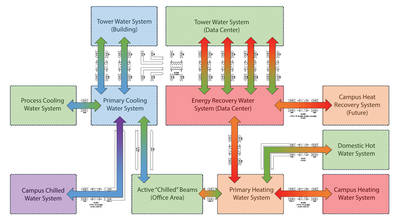
Water-cooled chillers, however, can add as much as 25% more heating energy in the process of cooling the building depending on efficiency. A heat-recovery chiller (or water-to-water heat pump) takes the heat normally rejected to the cooling tower, together with this additional heating energy from the chiller, to provide beneficial heating at the building. Waste heat recovered in this manner not only reduces the heating energy required in the building, but it also reduces cooling tower energy and water consumption.

This approach provides a significant improvement over electric heating systems (with no waste heat recovery), but can fall short of the combined energy savings of high-efficiency chillers and natural gas condensing boilers.
RTEmagicC_CSE1508_MAG_FHEAT_02_txdam232077_d010af

Process waste heat recovery

Waste heat also can be extracted from equipment or processes within the building. Hot boiler or microturbine exhaust may be used as a source of waste heat. Waste heat from steam boilers can be used to preheat boiler feed water. This same heating energy, if of sufficient quality, quantity, and regular operation, can be used for building heating as well as building cooling via absorption chillers. In an absorption chiller, the waste heat drives a refrigeration cycle that provides chilled water for building cooling. Note this approach is more commonly associated with natural gas-fired microturbines that regularly provide electrical load-shedding during periods of peak electrical demand.

Process waste heat (in the form of hot air) also can be used to provide for dehumidification within the building. Dehumidification units generally use desiccant media to absorb moisture from the air (latent energy recovery). Removing moisture from the desiccant media, however, requires a hot and relatively dry air stream to draw out the moisture from the desiccant. If the building has systems in place that generate significant amounts of hot air, this approach may be a viable alternative to cooling-based dehumidification systems. Refer to ASHRAE 62.1, Section 5.17, for limitations.

Common elements of waste heat recovery

A common thread in waste heat recovery is this concept of recycling. Energy that would otherwise be thrown away is instead converted into beneficial use within the building. Unless you intentionally focus on waste heat recovery at the beginning of design, however, your options for implementation can be very limited. The building systems selected will either enhance or limit the application of these approaches. For example, water-based heating systems designed for lower water temperatures will increase the opportunities to recover waste heat.

Too often we fail to see the wasted energy use. We instead concentrate on implementing more efficient heating and cooling systems, not considering potential energy reuse. When we do see potential applications for waste heat recovery, many times we will limit our vision to what can be done for a particular project or building. When we take a step back, though, we can then begin to envision larger applications for waste heat recovery beyond the needs of our building. When realized, these larger applications can lead to significant energy savings, not only to the project but also to the campus.

Publicado em Artigos Tecnicos, Eficiência Energética, Sustentabilidade | Com a tag , , , , , , | Deixe um comentário

Bolha imobiliária no Brasil

Fonte: Revista INFRA

Por: Pericles Batista Passos

Acesse aqui a matéria em sua fonte.

Confira quais são os seus mitos e verdades

Na última década, muito tem se discutido sobre bolha imobiliária no Brasil. Esse tema bastante polêmico tem atraído diversas opiniões de especialistas no assunto, tornando-se inevitável as comparações com a crise do mercado financeiro americano em um passado não muito distante, alertando, bem assim, para uma possível repetição do caos imobiliário ocorrido naquele país.

Os valores absurdamente altos de propriedades em grandes cidades do Brasil, mais precisamente nos últimos cinco anos, faz lembrar o colapso do mercado imobiliário dos EUA que ajudou a motivar a crise financeira global de 2008 e 2009.

Muito se discutia que a exponencial expansão dos investimentos no mercado de imóveis no Brasil poderia se tornar um tanto perigosa, porque quando esses investidores não mais soubessem reconhecer que os crescentes preços dos ativos estavam se distanciando de fundamentos econômicos, poder-se-ia estar surgindo uma perigosa bolha financeira.

Entretanto, a realidade brasileira atual aponta para outro caminho. A recessão da economia ocasionou a estabilização dos preços dos imóveis e a perda de interesse de investidores, notadamente porquanto o investimento em imóveis se tornou um negócio de risco, fazendo com que a bolha no mercado imobiliário passasse a desinchar lentamente, e não estourar.

Esse afastamento dos investidores do setor imobiliário, curiosamente se tornou um ponto positivo para as construtoras, na medida em que para essas empresas se vislumbrou uma oportunidade para focar na geração de caixa. Isso porque, a estabilização do mercado proporciona um cenário mais realista e faz com quem as empresas do setor possam planejar melhor seus projetos e adaptar seus custos e estrutura a essa realidade.

O mercado imobiliário brasileiro apresentou fortes aumentos nos preços dos imóveis nos últimos anos, tendo seu ápice em meados de 2007, onde os preços praticamente dobraram de valor. A atuação incisiva dos investidores e especuladores nesse ramo da economia aliada ao incentivo do governo através do aumento da concessão de crédito para financiamento imobiliário, fez com que se especulasse sobre uma repetição do caos imobiliário dos EUA.

No entanto, tal especulação não chegou a se concretizar, porque os dois países viveram situações distintas. No Brasil, a dívida imobiliária com os créditos oferecidos pelo governo é infinitamente menor daquela experimentada pelos EUA na época, pelo seguinte motivo: a disciplina na concessão de crédito pelo Brasil é muito maior que a americana, tanto assim o é, que a inadimplência em nosso país continua sob controle.

Ademais, algumas fontes de demanda contribuíram para o crescimento dos preços no Brasil, como por exemplo, o chamado “bônus demográfico” que é o efeito de uma alta taxa de natalidade nas últimas décadas, que inevitavelmente tende a formar uma população jovem que certamente irá contrair matrimônio com expectativa de adquirir imóveis futuramente.

Outra fonte de demanda importante reside na melhora da condição de vida do cidadão brasileiro, fazendo com que a capacidade de conseguir financiamentos para compra de imóveis aumentasse, incentivando assim a aquisição de um imóvel com padrão superior e o “sonho da casa própria” para aqueles que pagavam aluguel.

Por último, mas não menos importante, temos os investidores (pessoas físicas ou jurídicas) que compram imóveis mais baratos na planta para revendê-los posteriormente a fim de obter lucro com a transação.

Dessas três fontes de demanda principais, apenas o “bônus demográfico” se mantém nesse panorama atual, uma vez que com a recessão da economia os investidores se afastaram do mercado, as pessoas que procuram “upgrade” estão mais cautelosas na hora da compra e aqueles que moram em imóveis alugados têm encontrado mais dificuldades na concessão de crédito para comprar imóveis.

Diante desse cenário, o risco da explosão de uma eventual bolha reduziria drasticamente. E foi o que aconteceu. Não obstante, outros fatores característicos do mercado residencial foram essenciais para que fosse afastada qualquer especulação de bolha imobiliária no Brasil.

*Pericles Batista Passos é advogado do escritório Lapa & Góes e Góes Advogados Associados, especialista em Direito e Processo do Trabalho pela Faculdade Baiana de Direito – FBD e pós-graduando em Direito Processual Civil pela Universidade Anhanguera – UNIDERP.

Publicado em Brasil, Real Estate e Mercado Imobiliário | Com a tag , , , | Deixe um comentário

ASHRAE Proposes Standard To Serve As “Backbone” Of Valid Rating Systems

Fonte (Source): ASHRAE

Por (By): Jodi Scott

Acesse aqui a matéria em sua fonte.

Contact: Jodi Scott
Public Relations
678-539-1140
jscott@ashrae.org

ATLANTA – While many building rating programs exist worldwide, there is not anything in the industry that standardizes the contents of those programs, ensuring users are knowledgeable about what impacts their ratings.

A proposed standard from ASHRAE, currently open for public comment, would serve as the “backbone” of such rating systems.

ASHRAE Standard 214P, Standard for Determining and Expressing Building Energy Performance in a Rating Program, is being written to standardize building energy rating programs by requiring the minimum content of any labels associated with rating programs, establishing minimum requirements for rating program documentation and other essential components in rating programs.

The proposed standard is currently open for public comment until Sept. 28, 2015. To learn more or to comment, visit www.ashrae.org/publicreviews.

“There are many entities that are rating buildings utilizing a number of different building rating systems yielding varying results,” Wayne Stoppelmoor, chair of the Standard 214P committee, said. “Feedback from government and regulatory agencies has shown there is an overwhelming need for a standard that provides uniformity in the building energy labeling and disclosure process. We want to provide a non-commercial consensus standard that can be used in international, national and regional legislation, policy making and regulation activities. The goal is to write a standard that provides guidance for establishing rating systems that produce meaningful and consistent results.”

Stoppelmoor said he sees the proposed standard as a way to identify what rating systems should be used to comply with building energy disclosure ordinances and as a guideline for those developing rating systems. It is anticipated that the proposed standard will have minimal impact on existing rating systems.

The standard would establish requirements for:

  • Disclosure of building energy use via  a rating label and supporting summary documentation
  • Determining and expressing energy use, with metered data, of buildings and building sites that are in operation
  • Acceptable credentialing criteria for individuals applying the standard and reporting building energy use
  • Pre-occupancy (design) and post-occupancy (in operation) conditions
  • Format and content of the rating disclosure, the label and supporting documentation.

ASHRAE, founded in 1894, is a global society advancing human well-being through sustainable technology for the built environment. The Society and its more than 50,000 members worldwide focus on building systems, energy efficiency, indoor air quality, refrigeration and sustainability. Through research, standards writing, publishing, certification and continuing education, ASHRAE shapes tomorrow’s built environment today. More information can be found at www.ashrae.org/news.

Publicado em Eficiência Energética, Mundo, Normas Técnicas, Sustentabilidade | Com a tag , , , , , | Deixe um comentário