Recycling 101: waste heat recovery

Fonte (Source): Consulting-Specifying Engineer

Por (By): Robert Thompson, PE, SmithGroupJJR Inc., Phoenix

Acesse aqui a matéria em sua fonte.

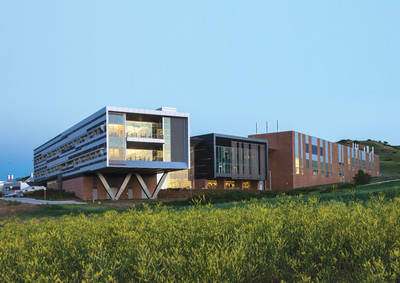
Waste heat recovery systems are increasingly used in mixed-use buildings to move waste heat from laboratories, data centers, or industrial activities to provide beneficial heating in other parts of the building. Recovering waste heat becomes an attractive option for facilities working to achieve low energy use (such as net zero energy or high-performance buildings) and to reduce emissions.

Learning Objectives

  • Visualize the flow of energy within buildings and learn the importance of energy benchmarking.
  • Outline the codes and standards that define energy efficiency and waste heat recovery in buildings.
  • Understand the thought process behind the integration of waste heat recovery into building cooling and heating systems.

In 2012, buildings accounted for 74% of all the electrical energy use within the United States. As buildings are large consumers of electricity, there has been a concerted effort to improve their energy efficiency (and reduce wasted energy). ASHRAE Standard 90.1: Energy Standard for Buildings Except Low-Rise Residential Buildings is the energy benchmark for buildings, which is updated every few years with more stringent energy guidelines. Buildings also are designed based on the U.S. Green Building Council’s LEED guideline, which encourages increased energy performance. Energy Star is another program that encourages reduced energy usage for equipment and appliances within buildings.

As a result of these programs, the energy efficiency and relative energy use within buildings is coming down. The U.S. Energy Information Administration’s (EIA) Commercial Building Energy Consumption Survey (CBECS) provides energy benchmarks for a variety of building types. The energy use intensity (EUI) is a measure of a building’s energy use per square foot per year (kBtu/sq ft/yr). An average university within the CBECS database in 2014 had a site EUI of 130 due to the large number of classrooms, laboratories, and technology-driven spaces. The average site EUI for an office within the same CBECS database for 2014 was 67, which is a significant improvement from 1995 when the average site EUI for an office was slightly higher than 100. While these programs have made and continue to make significant reductions in building energy use, there is still room for improvement by taking some lessons in recycling and waste heat recovery.

A large facility containing laboratories and offices built today likely has central chilled and heating water systems. The use of water-based systems for space conditioning is preferred as it allows for precise temperature and humidity control while reducing the total amount of heating and cooling capacity installed at the facility. Water-based cooling systems are either air-cooled, ground-source water-cooled, evaporative-based water-cooled, or a combination of these approaches. Air-cooled systems reject heat to the atmosphere while ground-source systems reject heat to the earth (through geothermal wells or deep lake-based cooling). Both approaches reduce system complexity and local water consumption, with ground-source systems being more efficient due to reduced fan energy (required to reject heat to the air).

Evaporative-based water systems evaporate water via a cooling tower or fluid cooler to offset the heat generated within the building. The heat of evaporation for water is high, which significantly improves energy performance relative to air-based cooling systems. While the local water consumption increases with this approach, the improvements in energy efficiency can result in a net water savings by reducing water consumption at utility power plants.

RTEmagicC_CSE1508_MAG_FHEAT_01_txdam232075_da60b2

Water-based heating systems generally use electricity, natural gas, or solar as the heating source. The use of electricity for building heating generally is limited to small systems, as it has a higher operating cost (due to the inefficiencies in its production and transportation losses to the building). Solar has a higher first cost and, unless it is stored, is limited to production during the daytime hours. Natural gas has the potential to be extremely efficient, especially when the boiler is designed to be condensing. Condensing boilers allow the products of combustion to condense outside the heating coil, extracting heat that is normally lost through the boiler stack.

Exhaust air waste heat recovery

Exhaust air waste heat recovery takes energy from the exhaust air and uses it to precondition outside air. This heat recovery may be based on the relative difference of sensible energy (temperature), latent energy (moisture content), or enthalpy (temperature and moisture content). Laboratories are generally limited to sensible heat recovery only (due to the potential to transfer chemicals with latent recovery) while office areas may take advantage of enthalpy-type energy recovery.

ASHRAE 90.1, Section 6.5.6 Energy Recovery, requires that such a system be installed based on airflow, climate region, percent outside air, and other factors. It provides exceptions, however, based on laboratory operation and components (according to ASHRAE 90.1, Section 6.5.7.2 Laboratory Exhaust Systems). One such exception is related to capacity control and the ability to turn down the ventilation airflow in the laboratory to 50% or less. ASHRAE 90.1 recognizes the benefits of being able to reduce ventilation rates to save energy.

Building on the concept of reducing ventilation rates, excess ventilation air for offices potentially can be recycled as single-pass air for laboratories, lowering the total ventilation for the building. Oftentimes the ventilation air to office areas can also be increased (beyond minimum levels) to provide a healthier environment. As long as the ventilation provided to the offices remains less than the minimum ventilation rates in laboratory areas (minus the laboratory’s required ventilation for people), there will be a net reduction in ventilation (and energy savings) for the building. Note that this approach requires special attention to ensure laboratory pressurization and directional airflow to protect non-laboratory spaces. Refer to ASHRAE Standard 62.1: Standard for Ventilation and Indoor Air Quality, Section 5.17 Air Classification and Recirculation, for additional information and limitations with this approach.

Condenser water waste heat recovery

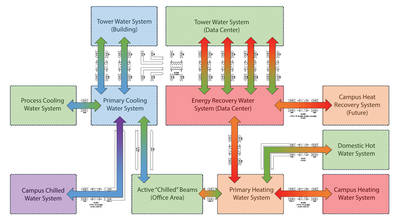
For water-based cooling systems, heat from the building is rejected to the chilled water system. The water-cooled chillers in the chilled water system then transfer heat (by cooling chilled water), rejecting it to cooling towers (or fluid coolers) via a condenser water system. Cooling towers then use airflow and direct evaporation to reject the building waste heat to the outdoors.

Water-cooled chillers, however, can add as much as 25% more heating energy in the process of cooling the building depending on efficiency. A heat-recovery chiller (or water-to-water heat pump) takes the heat normally rejected to the cooling tower, together with this additional heating energy from the chiller, to provide beneficial heating at the building. Waste heat recovered in this manner not only reduces the heating energy required in the building, but it also reduces cooling tower energy and water consumption.

This approach provides a significant improvement over electric heating systems (with no waste heat recovery), but can fall short of the combined energy savings of high-efficiency chillers and natural gas condensing boilers.
RTEmagicC_CSE1508_MAG_FHEAT_02_txdam232077_d010af

Process waste heat recovery

Waste heat also can be extracted from equipment or processes within the building. Hot boiler or microturbine exhaust may be used as a source of waste heat. Waste heat from steam boilers can be used to preheat boiler feed water. This same heating energy, if of sufficient quality, quantity, and regular operation, can be used for building heating as well as building cooling via absorption chillers. In an absorption chiller, the waste heat drives a refrigeration cycle that provides chilled water for building cooling. Note this approach is more commonly associated with natural gas-fired microturbines that regularly provide electrical load-shedding during periods of peak electrical demand.

Process waste heat (in the form of hot air) also can be used to provide for dehumidification within the building. Dehumidification units generally use desiccant media to absorb moisture from the air (latent energy recovery). Removing moisture from the desiccant media, however, requires a hot and relatively dry air stream to draw out the moisture from the desiccant. If the building has systems in place that generate significant amounts of hot air, this approach may be a viable alternative to cooling-based dehumidification systems. Refer to ASHRAE 62.1, Section 5.17, for limitations.

Common elements of waste heat recovery

A common thread in waste heat recovery is this concept of recycling. Energy that would otherwise be thrown away is instead converted into beneficial use within the building. Unless you intentionally focus on waste heat recovery at the beginning of design, however, your options for implementation can be very limited. The building systems selected will either enhance or limit the application of these approaches. For example, water-based heating systems designed for lower water temperatures will increase the opportunities to recover waste heat.

Too often we fail to see the wasted energy use. We instead concentrate on implementing more efficient heating and cooling systems, not considering potential energy reuse. When we do see potential applications for waste heat recovery, many times we will limit our vision to what can be done for a particular project or building. When we take a step back, though, we can then begin to envision larger applications for waste heat recovery beyond the needs of our building. When realized, these larger applications can lead to significant energy savings, not only to the project but also to the campus.

Publicado em Artigos Tecnicos, Eficiência Energética, Sustentabilidade | Com a tag , , , , , , | Deixe um comentário

Bolha imobiliária no Brasil

Fonte: Revista INFRA

Por: Pericles Batista Passos

Acesse aqui a matéria em sua fonte.

Confira quais são os seus mitos e verdades

Na última década, muito tem se discutido sobre bolha imobiliária no Brasil. Esse tema bastante polêmico tem atraído diversas opiniões de especialistas no assunto, tornando-se inevitável as comparações com a crise do mercado financeiro americano em um passado não muito distante, alertando, bem assim, para uma possível repetição do caos imobiliário ocorrido naquele país.

Os valores absurdamente altos de propriedades em grandes cidades do Brasil, mais precisamente nos últimos cinco anos, faz lembrar o colapso do mercado imobiliário dos EUA que ajudou a motivar a crise financeira global de 2008 e 2009.

Muito se discutia que a exponencial expansão dos investimentos no mercado de imóveis no Brasil poderia se tornar um tanto perigosa, porque quando esses investidores não mais soubessem reconhecer que os crescentes preços dos ativos estavam se distanciando de fundamentos econômicos, poder-se-ia estar surgindo uma perigosa bolha financeira.

Entretanto, a realidade brasileira atual aponta para outro caminho. A recessão da economia ocasionou a estabilização dos preços dos imóveis e a perda de interesse de investidores, notadamente porquanto o investimento em imóveis se tornou um negócio de risco, fazendo com que a bolha no mercado imobiliário passasse a desinchar lentamente, e não estourar.

Esse afastamento dos investidores do setor imobiliário, curiosamente se tornou um ponto positivo para as construtoras, na medida em que para essas empresas se vislumbrou uma oportunidade para focar na geração de caixa. Isso porque, a estabilização do mercado proporciona um cenário mais realista e faz com quem as empresas do setor possam planejar melhor seus projetos e adaptar seus custos e estrutura a essa realidade.

O mercado imobiliário brasileiro apresentou fortes aumentos nos preços dos imóveis nos últimos anos, tendo seu ápice em meados de 2007, onde os preços praticamente dobraram de valor. A atuação incisiva dos investidores e especuladores nesse ramo da economia aliada ao incentivo do governo através do aumento da concessão de crédito para financiamento imobiliário, fez com que se especulasse sobre uma repetição do caos imobiliário dos EUA.

No entanto, tal especulação não chegou a se concretizar, porque os dois países viveram situações distintas. No Brasil, a dívida imobiliária com os créditos oferecidos pelo governo é infinitamente menor daquela experimentada pelos EUA na época, pelo seguinte motivo: a disciplina na concessão de crédito pelo Brasil é muito maior que a americana, tanto assim o é, que a inadimplência em nosso país continua sob controle.

Ademais, algumas fontes de demanda contribuíram para o crescimento dos preços no Brasil, como por exemplo, o chamado “bônus demográfico” que é o efeito de uma alta taxa de natalidade nas últimas décadas, que inevitavelmente tende a formar uma população jovem que certamente irá contrair matrimônio com expectativa de adquirir imóveis futuramente.

Outra fonte de demanda importante reside na melhora da condição de vida do cidadão brasileiro, fazendo com que a capacidade de conseguir financiamentos para compra de imóveis aumentasse, incentivando assim a aquisição de um imóvel com padrão superior e o “sonho da casa própria” para aqueles que pagavam aluguel.

Por último, mas não menos importante, temos os investidores (pessoas físicas ou jurídicas) que compram imóveis mais baratos na planta para revendê-los posteriormente a fim de obter lucro com a transação.

Dessas três fontes de demanda principais, apenas o “bônus demográfico” se mantém nesse panorama atual, uma vez que com a recessão da economia os investidores se afastaram do mercado, as pessoas que procuram “upgrade” estão mais cautelosas na hora da compra e aqueles que moram em imóveis alugados têm encontrado mais dificuldades na concessão de crédito para comprar imóveis.

Diante desse cenário, o risco da explosão de uma eventual bolha reduziria drasticamente. E foi o que aconteceu. Não obstante, outros fatores característicos do mercado residencial foram essenciais para que fosse afastada qualquer especulação de bolha imobiliária no Brasil.

*Pericles Batista Passos é advogado do escritório Lapa & Góes e Góes Advogados Associados, especialista em Direito e Processo do Trabalho pela Faculdade Baiana de Direito – FBD e pós-graduando em Direito Processual Civil pela Universidade Anhanguera – UNIDERP.

Publicado em Brasil, Real Estate e Mercado Imobiliário | Com a tag , , , | Deixe um comentário

ASHRAE Proposes Standard To Serve As “Backbone” Of Valid Rating Systems

Fonte (Source): ASHRAE

Por (By): Jodi Scott

Acesse aqui a matéria em sua fonte.

Contact: Jodi Scott
Public Relations
678-539-1140
jscott@ashrae.org

ATLANTA – While many building rating programs exist worldwide, there is not anything in the industry that standardizes the contents of those programs, ensuring users are knowledgeable about what impacts their ratings.

A proposed standard from ASHRAE, currently open for public comment, would serve as the “backbone” of such rating systems.

ASHRAE Standard 214P, Standard for Determining and Expressing Building Energy Performance in a Rating Program, is being written to standardize building energy rating programs by requiring the minimum content of any labels associated with rating programs, establishing minimum requirements for rating program documentation and other essential components in rating programs.

The proposed standard is currently open for public comment until Sept. 28, 2015. To learn more or to comment, visit www.ashrae.org/publicreviews.

“There are many entities that are rating buildings utilizing a number of different building rating systems yielding varying results,” Wayne Stoppelmoor, chair of the Standard 214P committee, said. “Feedback from government and regulatory agencies has shown there is an overwhelming need for a standard that provides uniformity in the building energy labeling and disclosure process. We want to provide a non-commercial consensus standard that can be used in international, national and regional legislation, policy making and regulation activities. The goal is to write a standard that provides guidance for establishing rating systems that produce meaningful and consistent results.”

Stoppelmoor said he sees the proposed standard as a way to identify what rating systems should be used to comply with building energy disclosure ordinances and as a guideline for those developing rating systems. It is anticipated that the proposed standard will have minimal impact on existing rating systems.

The standard would establish requirements for:

  • Disclosure of building energy use via  a rating label and supporting summary documentation
  • Determining and expressing energy use, with metered data, of buildings and building sites that are in operation
  • Acceptable credentialing criteria for individuals applying the standard and reporting building energy use
  • Pre-occupancy (design) and post-occupancy (in operation) conditions
  • Format and content of the rating disclosure, the label and supporting documentation.

ASHRAE, founded in 1894, is a global society advancing human well-being through sustainable technology for the built environment. The Society and its more than 50,000 members worldwide focus on building systems, energy efficiency, indoor air quality, refrigeration and sustainability. Through research, standards writing, publishing, certification and continuing education, ASHRAE shapes tomorrow’s built environment today. More information can be found at www.ashrae.org/news.

Publicado em Eficiência Energética, Mundo, Normas Técnicas, Sustentabilidade | Com a tag , , , , , | Deixe um comentário

Study: Smartest ‘Smart Building’ Owners Come from Retail, Manufacturing, Construction

Fonte (Source): Energy Manager Today

Divulgado por: ASHRAE

Por (By): Carl Weinschenk

Acesse aqui a matéria em sua fonte.

The most advanced smart building owners are in retail, process manufacturing, and construction, IDC found in a recent survey of 200 business owners, writes EnergyEfficiencyMarkets.com.

Of the smartest building owners identified in the study, about 40% focused on HVAC technology, about 28% on lighting, about 41% on plug loads, and about 21% on distributed energy. About 37% also focused on analytics.

Companies that focus on lighting and HVAC look for systems that are able to integrate with other building systems. They look for analytics and data management that can integrate data from a variety of sources and can automate and optimize building operations, according to the MaturityScape Benchmark: Smart Buildings in the United States report.

Earlier this month, IDC outlined the “Stages of Maturity” in terms of smart buildings in 2015:

  • Level 0: Baseline
  • Level 1: Stakeholder Alignment
  • Level 2: Preliminary Action
  • Level 3: Adaptive Action
  • Level 4: Optimization

IDC says Level 1 is a key step in the smart buildings maturity process, because it is at this point that broader decision makers come together to outline investment priorities.

Publicado em Artigos Tecnicos, Eficiência Energética, Sustentabilidade | Com a tag , , , , , , , , | Deixe um comentário

Solving noise, vibration problems in HVAC systems

Fonte (Source): Consulting-Specifying Engineer

Por (By): Bradley N. Rohloff, PE, LEED AP, Harley Ellis Devereaux, Southfield, Mich.

Acesse aqui o artigo em sua fonte.

Vibration, sound, and noise can be mitigated by designing HVAC systems properly, which may include isolation pads, flexible pipe connectors, or other means.

Learning objectives

  • Understand the factors that may cause noise or vibrations in HVAC systems.
  • Learn various methods to mitigate vibration, sound, or noise problems.

In the HVAC industry, most sound or noise is generated via rotating equipment and air and fluid movement through ducts and pipes. This movement creates vibration, sound, or noise. Technically, sound is a wave of mechanical energy that moves through matter. Noise is undesirable sound or sound without value. In this discussion, we will use sound and noise synonymously.

Vibration in its simplest form can be considered an oscillation or repetitive motion of an object around an equilibrium position. In the HVAC industry, sound is not generated without some form of vibration from equipment. Although sound is not present without vibration, there can be vibration without sound noticeable to the human ear.

Therefore, the best way to reduce sound is to limit the vibration produced by mechanical equipment. Examples are rotating shafts or gears, thermal processes such as combustion, or fluid dynamic means such as airflow through a duct or fan interactions with air.

Understanding vibration and sound

Control of HVAC system sound and vibration are of equal importance, but measurement of vibration is often not necessary to determine sources or transmission paths of unwanted sound or noise. Because vibration is the source of noise from HVAC systems, management of those conditions is imperative to a quiet design. System design that neglects to properly address vibration may result in malfunctioning components, noise, and, in some cases, catastrophic failure.

There are two facets of vibration management: isolation and damping. Isolation is the prevention of vibration from entering the system and dissipating it by changing kinetic energy of vibration into a different form of energy, such as heat.

Vibration isolation systems for mechanical components require some amount of damping. Damping dissipates mechanical energy from the system and attenuates vibrations more quickly. Without damping, these systems may vibrate for some time before coming to rest. The fluid in automotive shock absorbers is a kind of damper, as is the inherent damping in elastomeric (rubber) equipment mounts described below. This energy is converted to heat in the shock absorber or rubber mounts. There are also pads made of neoprene or cork used in equipment mounting that can be identified as damping devices. These two forms of vibration management are different from each other, but are often used in conjunction with each other to achieve the desired performance. In this discussion, vibration damping will generally fall under the category of vibration isolation.

RTEmagicC_CSE1507_DE_FNOISE_fig1

Sound vibrations act on the inner ear as “pressure waves,” which our mind translates as music or someone’s voice. The amplitude of the sound wave represents the loudness and is measured in decibels. The louder the sound, the larger the amplitude or decibels (see Figure 1).

A- and C-weighted sound pressure 

A-weighted sound pressure (measured in decibels; dBA) has been used for 60 years as a single-number measure of the relative loudness of noise, specifically for outdoor environmental noise standards. It is popular because it is a single number that most sound meters include. A-weighted is “corrected” to more closely resemble the hearing characteristics of the human ear. The C-weighted curve (dBC), which is more sensitive to low-frequency sound, contributes less to the overall sound level than dBA. The human ear has a relatively poor sensitivity to low-frequency sound in the 20- to 30-dBA range.

When attenuating sound for an outdoor installation of an air-cooled chiller, the manufacturer-supplied decibel rating would be compared to design decibel level at the design distance from the source. If the design level is exceeded, attenuation will be required. Acoustic screen walls or manufacturer-supplied attenuation enclosures can be added, or relocating the chiller farther from the sound-sensitive area may be the answer.

Publicado em Artigos Tecnicos | Com a tag , , , , , , , | Deixe um comentário

Vibration management

Fonte (Source): Consulting-Specifying Engineer

Por (By): Bradley N. Rohloff, PE, LEED AP, Harley Ellis Devereaux, Southfield, Mich.

Acesse aqui a matéria em sua fonte.

There are several vibration isolators available; select the best option for the application.

Below are a few of the many vibration isolators available on the market used to isolate, reduce, or eliminate the transmission of vibration from equipment to the building housing the equipment.

Inertia bases and rail products—Inertia bases are recommended for equipment such as compressors, which can exhibit high out-of-balance forces and “top-heavy” equipment like belt-driven pumps. The concrete base reduces the amount of vertical movement and lowers the center of gravity, increasing the plan area at the base of the installation, improving stability. By adding the concrete to the base, stiffness is added, providing rigidity so the whole system can then be point-loaded on springs. The concrete surface also provides a surface that allows the pump frame to be filled with grout as required by the pump manufacturer. Without the mass of the concrete, a point-supported, base-mounted pump would quickly wear out the coupling.

Isolation padsPads may be used for small equipment to supplement air-handler internal isolation, or where there is little to no acoustical sensitivity. Isolation pads manufactured of cork and neoprene are available in many sizes. In situations where the cork and neoprene pads are not adequate, an alternative is the neoprene pad, which yields more deflection and better results than the neoprene and cork pad.

Spring hangersSpring hangers comprise 1-in. deflection for steel helical springs of various load ratings housed in steel boxes. All hangers can be fitted with a load-transfer plate to hold the equipment or piping at a fixed elevation during installation. The critical characteristic for an isolation hanger is the clearance between the hanger rod and the hole at the bottom of the hanger box.

Rubber flexes—Rubber flexes are recommended for all piping connections to pumps, chillers, cooling towers, and air-handlers. Rubber flexes are the only connector type effective in reducing disturbances associated with the pumps pulsation frequency. Use two arch connectors wherever possible to maximize vibration and noise reduction. To ensure durability, look for connectors with DuPont Kevlar reinforcing and a steel ring embedded in the rubber flange in lieu of cable retention.

Stainless steel flexible pipe connectorsIn lieu of flexible rubber pipe connectors, braided stainless flexible connectors—though not as effective as rubber—can reduce vibration transmission from equipment to connected piping. They are necessary in lieu of rubber for temperatures higher than 250 F and when pressures are higher than those published for rubber. Because stainless steel cannot expand, neither the stainless connectors nor a series of pipe couplings can provide the same attenuation benefits as the elastomeric flex.

Rooftop unit vibration isolation—Rooftop units are a frequent source of noise and vibration complaints. All rooftop units, regardless of manufacturer, are supplied with “internal vibration spring isolators” under the fans. The rooftop unit is frequently mounted on the most flexible part of the roof, typically directly over the most noise-sensitive areas of the building. Installation of a spring-isolation curb is the recommended solution to the problem.

Bradley N. Rohloff is an associate in mechanical engineering at Harley Ellis Devereaux.

Publicado em Artigos Tecnicos | Com a tag , , , , | Deixe um comentário

Rio de Janeiro será sede do Congresso e EXPO ABRAFAC 2015

A Associação Brasileira de Facilities – ABRAFAC confirmou o Rio de Janeiro
como cidade sede para o Congresso e Expo ABRAFAC 2015. O evento, que é o
maior do calendário de Facilities do Brasil, será realizado em novembro. Em
seus três dias de duração, contará com palestras, exposição de empresas do
segmento de serviços e apresentação dos concorrentes ao Prêmio ABRAFAC
Melhores do Ano 2015.
Acesse aqui a página oficial da ABRAFAC.

Publicado em Congressos, Facility Management | Com a tag , , | Deixe um comentário

Ycon Formação Continuada divulga Curso de Gestão da Operação & Manutenção Predial em SP

Gestão da Operação & Manutenção Predial

CÓDIGO: AB-192

19 de setembro de 2015

Objetivos:
– Apresentar aos participantes os principais sistemas prediais existentes em uma edificação comercial, suas características, os seus pontos de atenção e os eventuais impactos ocasionados por uma falha na infra-estrutura;

– Apresentar aos participantes os principais conceitos e práticas relacionadas a “Gestão Estratégica da Manutenção” comumente aplicados na área predial;

– Aplicar dinâmicas em grupo promovendo a comunicação / conhecimento entre os participantes, assim como a troca de opiniões e o aprendizado sobre os conceitos apresentados.

Conteúdo Programático
– Introdução ao tema – O mercado de O&M Predial
– Introdução às Instalações Prediais tipicamente existentes em uma Edificação Comercial
– O&M – Conceituação e Tipologia
– Gestão Estratégica da Manutenção:
– Planejamento Estratégico – Políticas e Diretrizes
– Planejamento & Controle da O&M – Etapas e Melhores Práticas
– Planos de Ação – Estruturação da Equipe e Implantação
– Sistema Informatizado de Gestão – Ferramentas e Particularidades
– Principais causas de insucesso na O&M Predial
– Encerramento

Acesse aqui o site da Ycon para mais informações.

Publicado em Cursos & Seminarios / Congressos, Facility Management | Com a tag , , , | Deixe um comentário

Irregularidades de Uso em Edificações

Divulgado por: Instituto de Engenharia de SP

Por: Tito Lívio Ferreira Gomide

Acesse aqui o artigo em sua origem.

As irregularidades de uso em edificações seguem nossa tradicional rebeldia cultural, desde pequenos danos como riscos na cabina do elevador, ao furto de produtos, tais como os bicos de hidrantes, luminárias de emergência ou mesmo extintores de incêndio.

No conjunto das patologias prediais, classificadas pela Engenharia Diagnóstica como anomalias construtivas, falhas de manutenção e irregularidades de uso, estas últimas envolvem aspectos administrativos e técnicos bastante significativos.

As irregularidades de uso causam inúmeras situações de risco, desconforto e degradação precoce da edificação, sem embargo de também provocarem anomalias exógenas e falhas de manutenção nas edificações.

As principais irregularidades de uso consistem em alterações das utilizações projetadas originalmente nas edificações. Prédios de uso residencial, tipo quitinetes, por exemplo, com o tempo se transformam em prédios de uso misto, com inúmeros escritórios substituindo os apartamentos, e vice-versa, como ocorre com os pavimentos de escritórios de inúmeros prédios de Brasília, ora transformados em quitinetes.

Vagas de garagem se transformam em lava-jato, jardins viram playgrounds, salões de festa transformam-se em sala de fitness e por aí vai. Além disso, muitas instalações acessórias são feitas ao longo do tempo, tais como aquelas das tvs a cabo, ou equipamentos de segurança, sem os devidos cuidados técnicos, causando transtornos e riscos aos moradores e ocupantes de nossas edificações.

A colocação do lixo em local improvisado não é novidade em grande parte de nossas edificações, e as gambiarras elétricas para ligar o VAP e outros equipamentos elétricos também não.

Não bastassem esses abusos, ainda temos muitos usuários de nossas edificações com o vício da lei de Gerson, segurando o elevador num longo papo de despedida ou jogando as bitucas de cigarro por onde passam.

Sabemos que a higiene ainda não é prioridade nacional, e isso também prejudica nossas edificações e a saúde dos moradores, com os cachorrinhos “irrigando” as bases dos pilares e com os próprios usuários desrespeitando a água da piscina.

A degradação precoce dos elevadores projetados para prédio de uso residencial transformado em edifício de uso misto, por exemplo, é devido ao uso mais intenso dos elevadores além do maior número de paradas entre andares, o que não ocorre normalmente em edifício residencial.

As alterações de uso de lajes, em geral com a fixação de parafusos diretamente sobre os revestimentos e mantas de impermeabilização, para antenas e outros acessórios, são irregularidades rotineiras em nossas edificações, a causar infiltrações e danos estruturais consideráveis.

A utilização da água do lençol freático nas edificações, ou fornecida por terceiros, também é irregularidade que causa a degradação precoce das tubulações e instalações hidráulicas, devido à composição química inadequada da água. Instalações de equipamentos de ar-condicionado, e outros, sem a adequação ao projeto original, também provocam danos nas instalações elétricas e a degradação precoce.

Grande risco também oferecem as reformas com as retiradas de paredes ou elementos estruturais, sem o devido estudo técnico, muitas vezes favorecendo graves acidentes. Nesse sentido, muito providencial a recente norma técnica da ABNT nesse sentido, regulando o planejamento das reformas em edificações.

Poderíamos prosseguir com uma infinidade de outros exemplos de irregularidades de uso em nossas edificações, mas o presente artigo visa destacar, tão somente, as principais anormalidades técnicas causadas por tais comportamentos indevidos, principalmente no que tange à degradação precoce.
Importante se destacar que, para evitar esses desvios de uso, há necessidade de ensinamentos aos usuários, e isso tem sido exemplarmente feito através do manual do síndico e manual dos proprietários, fornecidos aos adquirentes no ato da entrega dos imóveis.
Alguns desses manuais possuem verdadeiros códigos de conduta e recomendações técnicas completas para bem manter a edificação e evitar as irregularidades de uso.

E é importante consignar que além dos acidentes, desconfortos e degradações, as irregularidades de uso contrariam as recomendações dos incorporadores e construtores nos manuais, podendo causar a perda de garantia do imóvel. Nesse sentido, segue a transcrição de alguns itens do texto de um desses manuais:
“Perda de Garantia

● Se durante o prazo de vigência da garantia não for observado o que dispões o Manual das Áreas Comuns e a NBR 5674 – das ABNT, Manutenção da Edificação, no que diz respeito à manutenção preventiva correta para imóveis habitados ou não;
● Se, nos termos do artigo 393 do Código Civil Brasileiro, atualizado em 2003, ocorrer qualquer caso fortuito, ou de força maior, que impossibilite a manutenção da garantia concedida;
● Se houver danos por mau uso, ou não respeitando os limites admissíveis de sobrecarga nas instalações e estruturas;(grifa-se)
● Se forem realizadas obras e modificações não previstas no Manual de Obras ou que não estejam em conformidade com as normas e ou legislação em vigor;
● Se não for elaborado e executado o Programa de Manutenção de acordo com a NBR 5674 da ABNT.”

Portanto, é fundamental o aculturamento dos proprietários e usuários de nossas edificações quanto ao bom uso e manutenção adequada, quer seja para evitar acidentes, manter o conforto e a higiene, evitar a degradação precoce, ou até mesmo preservar a garantia do imóvel.

Publicado em Artigos Diversos, Cidades, Leis | Com a tag , , , , , | Deixe um comentário

Economia aliada a sustentabilidade: Como condomínios residenciais podem reduzir o consumo de energia

Fonte: Procel Info

Por: Lara Martinho, com a colaboração de Juliana Mafra

Acesse aqui a reportagem em sua fonte.

A conta de energia elétrica pode representar de 12 a 30% das despesas de um condomínio, segundo a Companhia Energética de Brasília (CEB). Suprimir desperdícios e aperfeiçoar a eficiência no uso da energia são os meios necessários para alcançar a economia. Mobilizar os condôminos também pode ser uma forma de se atingir esse objetivo. A boa notícia para os gestores de condomínios é que a energia elétrica é um insumo gerenciável e que o consumo está diretamente ligado aos hábitos de uso e à qualidade dos equipamentos.

Reduzir o consumo de energia elétrica, não apenas combate o desperdício e reduz o valor financeiro dos gastos nas contas, como também ajuda na preservação do meio ambiente. A iluminação de áreas comuns nos condomínios são responsáveis por uma boa parte desses gastos. Uma das principais medidas utilizadas para essa redução é o mapeamento das condições de iluminação.

As lâmpadas LED são consideradas as mais sustentáveis porque oferecem características mais vantajosas do que as lâmpadas tradicionais. Economizam mais energia, possuem um maior fluxo luminoso, longa vida útil, além de não apresentar mercúrio em sua composição e nem emitir raios UV e infravermelhos. As mais eficientes possuem o Selo Procel. As fluorescentes compactas também são eficazes, sendo quatro a cinco vezes mais eficientes que as incandescentes. As lâmpadas Super LED e LED são diferenciadas pela potência, alta e baixa – até 0,5 W são de baixa potência (LED), acima disso são consideradas Super LED.

A escolha da lâmpada vai de acordo com cada ambiente e suas necessidades, levando assim considerações como custos de manutenção e gastos energéticos, o ideal é ter um profissional especializado no assunto para indicar durabilidade, temperatura de cor, tecnologia do produto, e se ele se adapta ao ambiente em questão. Além da substituição das lâmpadas, outra recomendação é manter os ambientes com cores claras, nas paredes e no teto, refletindo melhor a luz e diminuindo a necessidade de diversos pontos de luminosos.

No caso de sensores de presença o ideal é sua utilização em locais nos quais não é necessário manter as luzes ligadas o tempo todo, como locais de passagem ou de curta permanência. Recomenda-se seu uso com lâmpadas LED ou halógenas, estas possuem a mesma durabilidade das incandescentes e economizam 30% de energia. Seu uso com lâmpadas fluorescentes não é indicado, pois acarreta redução da vida útil devido à frequência com que são acionadas durante um dia.

Segundo Emerson Salvador, Gerente do departamento de desenvolvimento da eficiência energética da Eletrobras, o uso de elevadores muito antigos pode contribuir para o gasto de energia de forma demasiada. Além disso, o rodízio de elevadores pode ser uma alternativa interessante para economizar com eletricidade e na manutenção. Alguns edifícios já usam elevadores inteligentes, que buscam otimizar o tempo de deslocamento das pessoas e ajudam também na redução do consumo.

“Há outras dicas que colaboram com a economia em condomínios, como a instalação de sistemas de aproveitamento da água da chuva e a aplicação de placas solares para aquecimento de água para banho. Há empresas especializadas que podem oferecer opções aos condomínios. Ademais, é sempre indicado contratar um profissional habilitado para serviços em eletricidade”, ressalta Salvador.

O condomínio Cesar Cantinho, em Botafogo, é um exemplo de ação sustentável e do uso de energia solar para diminuir o consumo de energia elétrica.

“Sou gestora por formação e, quando assumi a sindicatura, constatei o muito que precisava ser feito para implementar uma gestão eficaz. Foram vários anos de trabalho intenso, contando com o inestimável apoio dos Conselheiros, para que o condomínio se tornasse sustentável e servisse como exemplo para outros que querem melhorar a gestão” – contou a sindica Henriette Krutman, que faz questão de investir na qualidade de vida de moradores e funcionários.

Além de todas as ações sustentáveis presentes no condomínio, a síndica precisou tomar uma importante decisão para reduzir os gastos com energia do prédio e acabou transformando-o no maior edifício do Brasil com água aquecida por energia solar. São cerca de 40 mil litros por dia.

Outra fonte de economia do condomínio foi substituir o gás utilizado pelas caldeiras por bombas de calor. Essa medida gerou uma redução mensal de cerca de R$12 mil. Com o gás se gastava em média R$ 15 mil, e com as bombas, entre agosto de 2008 e junho de 2014, o custo foi de R$3.590/mês.

O Secovi Rio, Sindicato da Habitação, promove de dois em dois anos um evento onde os prédios mais sustentáveis do Rio de Janeiro recebem uma premiação em dinheiro e um certificado. Na última edição, em 2014, os três premiados foram: Condomínio do Edifício Bandeirante Capitão Domingos, Todos os Santos; Condomínio do Edifício Gold River, Maracanã e Condomínio do Edifício Portofelice, Barra da Tijuca.

Essa iniciativa não somente estimula a economia de energia e preservação do meio ambiente, como também ajuda nas verbas do condomínio.

Publicado em Eficiência Energética, Sustentabilidade | Com a tag , , , , | Deixe um comentário