Rio de Janeiro recebe evento sobre gestão e sustentabilidade em edificações e projetos

Fonte: ABRAFAC

Data da Notícia: 09/11/15

Com o objetivo de promover discussões sobre gerenciamento de espaços e construção sustentável, a ABRAFAC promove no dia 25 de novembro de 2015, no Rio de Janeiro o Workshop ABRAFAC CREA 2015. O evento é destinado a engenheiros, construtores, arquitetos e profissionais envolvidos com construção sustentável e será realizado no auditório do CREA-RJ. “Estamos com muitas expectativas para este evento. A gestão do espaço, construção e gerenciamento de projetos em edificações são desafios na atividade atual dos facilities e, melhorar o desempenho desses serviços é de extrema importância”, conta o presidente da ABRAFAC, Luciano Brunherotto.

O evento contará com um ciclo de palestras ministradas pelos profissionais Wagner Oliveira, do Centro de Tecnologia em Edificações – CTE, Luiza Marinho, do Sindicato da Habitação do Rio de Janeiro – SECOVI, Manuel Lapa, do CREA-RJ, Antero Jorge Parahyba, do Instituto de Engenharia Legal, Ricardo Neves, consultor e Silvio Coelho, coordenador de fiscalização de manutenção predial da Prefeitura do Rio de Janeiro. “Será um dia repleto de conhecimento e troca de experiência entre grandes profissionais”, comenta Brunherotto.

O valor para participação é de R$ 200 e associados ABRAFAC possuem inscrição gratuita. Mais informações podem ser obtidas no site da entidade www.abrafac.org.br.

Serviço
Evento:
Workshop ABRAFAC CREA 2015 – Gestão & Sustentabilidade em Edificações e Projetos.
Dia:
25/11/2015 das 8h às 17h15
Local:
Auditório do CREA RJ
Rua Buenos Aires, 40 – Centro- Rio de Janeiro
Inscrições:
R$ 200 – Associados ABRAFAC possuem inscrição gratuita.

Publicado em Congressos, Cursos & Seminarios / Congressos, Facility Management, Sustentabilidade | Com a tag , , , , | Deixe um comentário

ABRAFAC entregará o Premio de Melhores do Ano em 2015

Apesar de bastante comum em países como França, Alemanha, Inglaterra e EUA, ainda prestigiamos de forma bastante singela as premiações de trabalhos e de profissionais ou empresas que se destacam em nossos mercados…

A ABRAFAC criou pouco depois de sua fundação um modelo de reconhecimento e premiação dos profissionais e empresas que obtêm destaque no mercado de Facility Management (Gestão de Facilidades) e nas diversas modalidades abrangidas, premiação esta que se tornou uma tradição, juntamente com o Jantar de encerramento.

Esta falta de cultura não se restringe somente ao fato de não prestigiarmos a premiação, pois se inicia ainda na etapa de inscrições de interessados em obter tal reconhecimento.

Apesar de sempre contarmos com trabalhos extremamente interessantes e inovadores, seja por apresentar uma nova técnica, seja por complementar e/ou ajustar uma técnica existente, o fato é que poderíamos ter um número muito maior de trabalhos inscritos, seguindo exemplos de fora de nosso país.

Deixo aqui a minha “dica”…

Vamos prestigiar o jantar e a premiação de 2015, já pensando na inscrição de nossos trabalhos para o evento que ocorrerá em 2016.

Segue abaixo a chamada para a premiação, com o link (na figura) que o redirecionará ao site.

Premio ABRAFAC 15.png


Publicado em Brasil, Premiações | Com a tag , | Deixe um comentário

“mea culpa”

Após todos estes anos escrevendo para o blog e divulgando eventos para os mercados de facilities e manutenção (além de temas voltados à sustentabilidade), eis que permaneci por algumas semanas “fora do ar”…

Não se trata de um afastamento forçado (saúde, viagem, etc), mas de um simples descontrole frente às atividades que me absorveram neste período…

Vamos retomando aos poucos a partir de hoje.

Abraços e uma ótima semana!!

Publicado em Artigos do Autor | Com a tag , , | Deixe um comentário

ABRAFAC realizará o FM Debate em CURITIBA, neste próximo 17/11

Abrafac Curitiba

Publicado em Eficiência Energética, Facility Management, Palestras, Sustentabilidade | Com a tag , , , , | Deixe um comentário

Wireless controls in building systems

Fonte (Source): Consulting – Specifying Engineer

Por (By): Don Horkey, PE, LEED AP, DLR Group

Acesse aqui a matéria em sua fonte.

There is quite a bit of flux in the wireless building instrumentation and controls protocol market with numerous players jockeying for dominance. Though wireless systems are becoming the norm for product manufacturers in many cases, not all engineers fully understand the best way to specify these systems.

Learning objectives

  • Summarize the various types of wireless building controls available for nonresidential buildings.
  • Identify the correct wireless control for each building type and application.
  • Demonstrate network security concerns and how to mitigate them

Wired building automation systems (BAS) have been successfully installed in both new construction and renovation projects for many years, and are the standard way a BAS is installed. Recently, wireless technology has become more prominent in the marketplace. This trend will continue, as a significant portion of the construction market consists of renovation work, and these projects pose difficulties for wired networks. As more flexibility is required in the built environment, wireless technologies can be easily reconfigured to support new building layouts.

Most wireless installations today are classified as hybrid systems because they are a combination of wired and wireless systems.

BAS systems are primarily composed of three tiers:

Tier 1 is the primary bus, sometimes referred to as the management level, that is typically a wired solution and generally uses BACnet/IP protocol. This level is where operator interface with the system typically occurs, and devices such as operator workstations, Web servers, and other supervisory devices are networked together.

CSE 17 Out 7

Tier 2 is the secondary bus and is commonly referred to as the automation level. It is also typically a wired solution and generally uses BACnet/IP, BACnet/MSTP, or LonTalk protocols. This level generally connects field controllers, programmable logic controllers, application-specific controllers, and major mechanical, electrical, plumbing, and lighting equipment.

Tier 3, or field level, is where end-user devices like thermostats and other sensors reside. While wireless networks can be used at all levels, this level is the most common implementation for wireless technologies due to their ease of installation, flexibility, and ease of relocation.

The wireless technology that is most widely used is WiFi (IEEE 802.11 a/b/g/n). This technology is extensively used in information technology (IT) systems. WiFi operates in the industrial, scientific, and medical (ISM) frequency bands and is capable of data rates up to 300 MB/sec (revision n). The data rates of a WiFi network are easy enough to support a very large BAS. Because this technology is so widely used, it is easily managed and maintained by most IT personnel. The disadvantage of WiFi is that it is a more expensive technology to deploy and it consumes considerably more power than other systems.

Reducing power consumption

ZigBee is a widely accepted wireless protocol used in the building automation industry. This level of acceptance typically keeps development and deployment costs lower than other protocols. Zigbee is based on the IEEE 802.15.4  standard. The standard specifies a maximum data rate of 250 kB/sec across a self-forming meshed network. Since Zigbee uses low data rates, the corresponding power consumption is also low and results in a long battery life. ZigBee operates in the same frequency bands as WiFi but can co-exist with WiFi networks when properly configured.

Most wireless-enabled controllers, repeaters, and sensors require some sort of power. The power typically is wired for WiFi  with the use of batteries for  Zigbee. Most battery-operated wireless sensor devices have a battery life of up to 5 yr, though this might vary widely depending on use in the building.

CSE 17 Out 8

Battery life is primarily affected by how far the information needs to be communicated, how much information is being transmitted or received, and how often the communication can be performed or cycled. Battery replacement and labor cost need to be considered in the lifecycle cost of the wireless system.

As another example, EnOcean devices use self-powered sensors that transmit data at a rate of 120 kB/sec in a mesh network at a low-frequency range. EnOcean devices utilize very low data and frequency rates. This allows EnOcean devices to have extremely low power consumption.  This allows the sensors to harvest energy from the environment to power them;  where sensors capture measured values, the energy state constantly changes. When a switch is pressed, the temperature alters or the luminance level varies. All these operations generate enough energy to transmit wireless signals. Because no batteries are required, the lifecycle cost of these devices can potentially cost less than battery-operated systems due to the elimination of the battery cost and battery-deployment labor cost.

Design and reliability

Wireless systems are required to have the same level of reliability as wired systems. These networks need to send and receive data continuously with minimal communication error. Designing, specifying, and implementing a reliable wireless network requires an understanding of mesh networks and intelligent routing options to ensure system data packets are successfully transmitted.

With proper planning and implementation wireless networks can be as reliable and secure as a wired network. Using wireless mesh networks with “smart” routing techniques, challenges like ensuring data packets successfully reach their destination can be mitigated.

A mesh network is a scalable network architecture where any device in the network can communicate to other devices by “hopping” over multiple access points. This allows the system to provide coverage over a much larger area, avoid single points of failure, and deliver high capacity. The network can be considerably less susceptible to interference and environmental conditions than a single access point can provide.

The building’s construction characteristics must be considered during the design and layout of a wireless network. Construction materials and obstructions have a significant impact on wireless performance. These factors determine the allowable distances between transmitters, receivers, and the number of repeaters that will be required throughout the building. Depending on the building type and owners’ tolerance for downtime, these devices can be connected to an emergency power source as well.

CSE 17 Out 9

Drywall and wood are excellent media for wireless signal propagation. Signal loss through concrete is dependent on its thickness and rebar spacing. Signal loss also can be significantly impacted by the quantity and type of steel superstructure, elevator shafts, and other metals used in construction and building geometry. All of these factors need to be understood and accounted for in project design specifications and construction drawings. The drawings and specifications should outline coverage, bandwidth performance, device options and quantities, and antenna locations to ensure proper wireless system performance and reliability. However, because existing buildings and renovations are a prime application of wireless technologies, reduced battery life is of significant concern due to the inability to change existing construction materials.

Publicado em Artigos Tecnicos, Eficiência Energética | Com a tag , , , , , , , , | Deixe um comentário

Building systems integration best practices

Fonte (Source): Consulting – Specifying Engineer

Por (By): Sanjyot V. Bhusari and Michael Watts, Affiliated Engineers Inc.

Acesse aqui a matéria em sua fonte.

Building automation systems (BAS) allow for state-of-the-art systems integration in nonresidential buildings.

Learning objectives

  • Measure the options available for building automation systems (BAS).
  • Compare the protocols for system integration.
  • Apply a BAS to improve energy efficiency.

hile 30 yr of advances in building automation have allowed owners to do more with less, the benefits remain accompanied by challenges. Open building automation system (BAS) communications protocols have made systems integration relatively easy, but in the absence of data and automation optimization, energy reduction, optimal maintenance, and greater staff productivity are being left on the table. Integrating otherwise disparate BAS into enterprise-level software platforms establishes a business case for state-of-the-art systems integration.

Systems should be integrated to solve business problems, and facilities owners are using systems integration to significantly improve key performance indicators ranging from energy and operational efficiencies to enhancing user experiences. A process-oriented approach to systems integration drives maximum benefit, beginning with the critical process of defining the problem. Developing detailed specifications and implementation strategies allows for the identification of best-value-based solutions. Incorporating requirements such as training for staff and vision for future systems will help sustain the benefits of the systems’ integration for the long term.

CSE 17 Out 6

The challenge, the breakthrough

Facilities owners historically have struggled with proprietary protocols that have hindered systems integration. Owners were often locked into one building automation vendor or had to deal with multiple stand-alone BAS, a circumstance that negatively affected their ability to negotiate cost and compromising their operational efficiency. Third-party equipment and disparate systems made proactive operation and maintenance difficult. Escalating energy and operational costs exacerbated shortcomings, and will continue to do so for the foreseeable future.

The evolution of BAS communication protocols from vendor-specific proprietary languages to more open industry-standard protocols has made systems integration relatively easy. Engineers are now routinely specifying third-party equipment such as chillers, boilers, and variable frequency drives to be integrated with the BAS. In many instances, owners already have multiple BAS integrated into an enterprise-level software platform, allowing them flexibility in selecting building controls based on value while simultaneously maintaining a consistent user interface for operational efficiency.

While open-communication protocols have largely solved one fundamental systems integration problem, facility managers face another challenge, namely, data deluge. Thinking beyond the immediate problem of communication between the systems and prioritizing management of building data in support of owner business goals is vital to effectively developing and specifying systems integration solutions. Successful use of data and the automation and optimization of facility-management work processes is where the real value of systems integration can be achieved.

A process-based approach

A process of four critical steps forms a basis for maximizing the benefits of integration:

1. Scope definition

Any systems integration scope discussion should start with the identification of myriad challenges that need to be addressed and a mechanism to measure success after the integration work has been completed. In this vein, solving a single problem may prove to have multiple benefits. Thinking through all the benefits and developing a detailed business case prior to finalizing systems integration scope establishes criteria for prioritization and selection. Too often, the full complement of benefits possible through systems integration is left unrealized. An ideation-type workshop that brings multiple stakeholders together in a structured manner can facilitate the discovery of all the possible opportunities, thus allowing the organization to act in the context of their business goals.

One large university in the Midwest implemented a series of ideation workshops to help reduce their rising energy cost. To address this challenge, a strategy to integrate class schedules with BAS was identified and developed. Linking class schedules with BAS would allow for energy savings when classrooms were not used. Further exploration revealed the need for class schedule information in resolving work orders as well. By passing the class schedule information into work-order management software, work orders could be scheduled around class times, thereby reducing the time wasted by maintenance staff waiting for classes to finish to gain access to that space.

Publicado em Artigos Tecnicos, Eficiência Energética | Com a tag , , , , , , | Deixe um comentário

Building automation + integration = efficiency

Fonte (Source): Consulting – Specifying Engineer

Por (By): Anil Ahuja, CCJM Engineers, Chicago, and Rocky Moore, American Auto-Matrix

Acesse aqui a matéria em sua fonte.

The building automation system (BAS) has become key to ensuring all systems within a building are working effectively and efficiently. Integration of lighting, HVAC, fire/life safety, and all other engineered systems requires the designer to specify an appropriate system.

Learning objectives

  • Compare various protocols that govern the building automation system (BAS).
  • Demonstrate how to integrate all systems into a “smart building” for the most effective integrated design of automation and control systems.
  • Apply a BAS to improve energy efficiency within a building.

With the influx of the Smart Grid and smart mobile applications, the building automation system (BAS) landscape has developed much faster than mechanical, electrical, plumbing (MEP), and fire protection products over the past decade. It is the driving force for optimized operations, improved reliability, and energy savings through the integration of building systems critical to the functionality of a facility.

CSE 17 Out 4

Through the years, occupancy, comfort, safety, reliability, and efficiency have been key factors in the development of the technologies. However, as the global conscience has changed with regard to the impact of humans on the environment, and global demand for and access to energy has risen, a new driving imperative has been placed on facility professionals, engineers, and building occupants. To put it another way, humanity’s goal is to reduce our energy consumption in a manner that significantly decreases the negative impacts the consumption has on our environment, and thereby on all of nature.

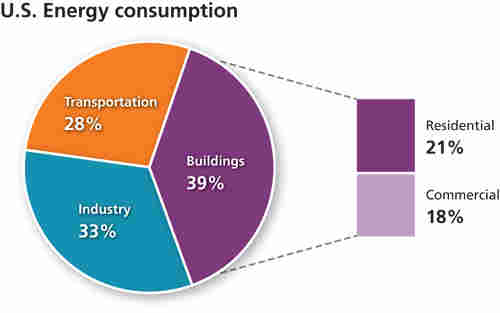
According to the Center for Climate and Energy Solutions, commercial and residential building space represents 39% of total energy consumption in the United States—more than any other sector—of which 70% is associated with HVAC systems, depending on location and environment (see Figure 1). Up to 30% is plug load and lighting. It stands to reason that integration and operation of these buildings to reduce energy consumption is a top priority. This can only be done through integration of the system with the use of technologies such as energy management and BAS, and by doing it in a manner that ensures the efficient operation of a facility. Combine this with the integration of a variety of devices via the Internet (the Internet of Things, or IoT) and software available as a monthly or annual service that does not require it be loaded on a local PC or server (the “cloud”). Engineers and designers have the ability to create more efficient buildings that use current technologies to decrease consumption. This can all be done while giving access to analytical tools designed to help pinpoint outlying operation and energy issues before they become a problem.

CSE 17 Out 5

The evolution of BAS

In the 1970s and ‘80s—due to increased energy prices—the demand for a more cost-effective building sent the BAS industry into a whirl of development to make buildings smarter. Taglines like “smart building solutions” started dotting the competitive landscape as building-automation companies were able to leverage cheapening computer technologies and bring them into the building space. This was a golden age for the BAS industry. During this peak demand to reduce consumption, BAS manufacturers globally created new and relevant technologies related to controlling a building. Competition increased and the direct digital-control solution became the standard expectation in buildings everywhere. However, most systems were disparate and only designed to control specific operations of a building, with other key components not being visible or integrated through the controlling mechanisms.

Over the next decade, the building automation landscape moved forward with larger leaps as technologies evolved at an almost exponential rate. During this time, energy prices inevitably fell and the larger cost-driven model for energy reduction began to wane as the economy strengthened. The pressure was off and, therefore, the pain soon forgotten. However, the building automation industry was still hard at work developing solutions relevant to the building market and energy reduction. The end user was beginning to ask for disparate systems that link together to allow for competitive selection of products as well as service providers.

Open protocols became an increasingly common topic of discussion as users realized the power of integration. During this time, our world was just beginning to understand the impact our energy consumption was having on the planet. However, we were still developing the solutions to dramatically reduce our environmental impact: open protocols for fully integrated systems. This was the beginning of the BACnet Project Standards Committee in 1987 (introduced as an ANSI/ASHRAE standard in 1995), and the introduction of LonTalk (now collectively referred to as LonWorks) protocol in 1990 by Echelon Corp. (It was submitted and accepted as an ANSI standard in 1999).

Today, the majority of buildings are designed with direct digital BAS. Through the evolution of protocols and technologies, the BAS has become a key component to ensuring the effective function of an entire building. In a perfect world, this would mean all buildings could take advantage of a “plug-and-play” system. However, it is not as easy due to market forces of constructing low-cost buildings and passing energy cost to leasing tenants in commercial buildings. Factors such as first cost, disparate manufacturers, legacy control systems, Internet security, and age of the building all come into play when considering the integration.

In addition, the ever-expanding cloud and the IoT has opened a whole new world of interconnectivity, allowing smart mobile devices and applications to be applied to these complex systems. Web browsers, software as a service (Internet-based software platforms, also known as SaaS), and mobile applications can be used to create a dynamic system where data-storage capacities are virtually limitless and access and control are just a touch away. With all this, the opportunity for efficiency is greater than ever. However, it is only through successful integration that this efficiency is achieved.

Publicado em Artigos Tecnicos, Eficiência Energética, Sustentabilidade | Com a tag , , , , , , | Deixe um comentário

Ensuring power quality in mission critical facilities

Fonte (Source): Consulting – Specifying Engineer

Por (By): Debra Vieira, PE, LEED AP, ATD, CH2M

Acesse aqui a matéria em sua fonte.

Many industrial, commercial, and service businesses are sensitive to power quality problems because they affect a company’s ability to compete in a global economy.

Learning objectives

  • Explain the definition of, and need for, high-quality power.
  • Identify the costs related to a power quality disturbances.
  • Recognize the value of gathering and interpreting data from power monitoring systems.

The generally accepted definition of clean power is “current and voltage waveforms that are purely sinusoidal.” However, this clean, or high-quality power does not have to be absolutely sinusoidal. So, what is the definition of high-quality power? Does the mere presence of harmonics on a power system indicate poor power quality? What about intermittent transients? Is that poor power quality?
CSE 17 Out 1

Technically, there is no single accepted definition of “quality power.” Standards exist that help define criteria that can be measured, such as voltage. However, the real measure of power quality is determined by the performance and productivity of end-user equipment. If the equipment is not performing correctly, verification of proper mechanical and electrical installation and maintenance is necessary. A faulty piece of equipment, bad bearings, or poor internal connections can affect performance. If this doesn’t resolve the problem then power quality is most likely inadequate.

When we discuss power quality, what we really mean is voltage quality—because it’s the quality of the voltage that we can address. Power is the rate of delivery of energy and is proportional to the product of the voltage and current. The equipment itself—not the distribution system—defines how much power is drawn from the system. The power system defines the quality of the voltage delivered. Because there is a close relationship between voltage and current, we must address the current to understand many of the power problems that exist. For example:

  • A short circuit can cause a voltage sag—or cause voltage to even disappear completely—due to extremely high current passing through the system impedance.
  • Lightning generates high impulse voltages that can travel on the power distribution system.
  • Distorted currents from harmonic loads also cause the voltage to distort as the current passes through the system impedance.

Sensitive electronic devices

We are heavy users of electronic devices, which are inherently sensitive to power quality. This sensitive equipment accentuates the limitations of the power system, limitations that have always existed but were rarely observed with less sophisticated equipment. Power quality issues are not easily identified. Determining how much of equipment malfunction and downtime is due to poor power quality is difficult to analyze. A power monitoring system that provides wave capture with a time stamp of the power anomaly, along with equipment status, can help facility operators correlate the cause and effect between power events and equipment malfunctions.

Since the advent of electricity, reliable, high-quality power has been desirable. In the late 1980s, computers became commonplace in our offices and homes. In the 1990s, we were able to network this equipment together to increase equipment performance.
CSE 17 Out 2

Today, we face new problems, such as faster processing speeds, increased computer chip densities, and equipment that is more sensitive to the quality of power it receives. Factories, offices, hotels, shopping centers, hospitals, and homes depend heavily on microprocessor-based loads, such as lighting controls, computers, copiers, appliances, scanners, control systems, monitoring devices, etc. It’s difficult to find equipment that lacks a microprocessor. While this electronic equipment is relatively small in size and power consumption, it is large in quantity and is in close proximity to one another.

We are interested in power quality because of its economic impact. An increasing majority of industrial, commercial, and service businesses are sensitive to power quality problems because they affect a company’s ability to compete in a global economy. Businesses that depend on high quality power, such as information technology or the continuous process industry with its programmable logic controllers, distributed control systems, industrial computers, human-machine interfaces, variable frequency drives (VFDs), motion controllers, and sensors, can suffer huge financial losses along with loss of productivity and competitiveness when power disturbances occur.

The costs related to a power quality disturbance can be categorized as direct costs, indirect costs, and inconveniences.

Direct costs: include reduced equipment efficiency, loss of raw material and production, equipment/product damage, corrupt data communications/storage, and nonproductive employee wages.

Indirect costs: more difficult to quantify and may include missed delivery deadlines, which may cause future orders to be lost.

Inconvenience: Items in this category are not expressed in lost revenue dollars but rather in how much someone is willing to pay to avoid having to deal with the inconvenience.

Ultimately, the end user is responsible for preparing appropriate performance criteria for the equipment as well as for the proper installation and correction of inadequacies in the power and grounding system. Unfortunately, many end users are unaware of the installation pitfalls and need assistance.

CSE 17 Out 3

Many times, the local utility company can provide guidance on how to properly install sensitive electronic equipment as well as modifications to the power and grounding system. The utility is motivated to provide customer service in regard to power quality to help build and maintain confidence in its distribution system. Utility engineers can provide troubleshooting analysis of harmonic issues because of the connection requirements stipulated in IEEE 519-2014: Recommended Practice and Requirements for Harmonic Control in Electric Power Systems, which defines the maximum allowed reflective harmonics allowed from a customer. However, some specialized equipment may be beyond the abilities of the utility and may require the assistance of an engineer who is knowledgeable in power quality issues.

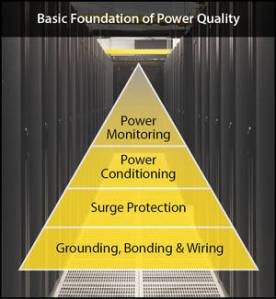
Having quality power is not accidental; it is well planned and carefully installed. The basics of power quality start by creating a solid foundation of grounding, bonding, and wiring; then layer on surge protection and power conditioning; and lastly, monitor power quality trends to provide a baseline for preventive maintenance activities to correct internal power quality problems and to define external power quality problems (see Figure 1).

Grounding, bonding, and wiring

Around 80% of all power quality problems are related to grounding, bonding, and wiring problems within a facility. Is this percentage exaggerated? Possibly, but many power problems are resolved simply by fixing a few grounding connections or replacing a couple of grounding cables.

Grounding and bonding are not the same. However, they are closely related. Why do we ground and bond electrical systems? The answer can be found in NFPA 70-2014: National Electrical Code (NEC), Article 250.4(A)(1) Electrical System Grounding, which states “Electrical systems that are grounded shall be connected to earth in a manner that will limit the voltage imposed by lightning, line surges, or unintentional contact with higher-voltage lines and that will stabilize the voltage to earth during normal operation.” Furthermore, grounding stabilizes the voltage to earth during normal operations for grounded systems. Electrical equipment is grounded in accordance with Article 250.4(A)(2) Grounding of Electrical Equipment, which requires that “Normally noncurrent-carrying conductive material enclosing electrical conductors or equipment, or forming part of such equipment, shall be connected to earth so as to limit the voltage to ground on these materials.”

Noncurrent-carrying conductive materials that may become energized are bonded together to establish a low-impedance ground-fault current path in accordance with NEC Article 250.4(A)(3) Bonding of Electrical Equipment, which indicates that “Normally noncurrent-carrying conductive materials enclosing electrical conductors or equipment, or forming part of such equipment, shall be connected together and to the electrical supply source in a manner that established an effective ground-fault current path.” Bonding of equipment facilitates the operation of overcurrent devices, such as fuses, circuit breakers, or relays, during fault conditions as required by NEC Article 250.4(A)(5). Multiple parallel paths result in low impedance to facilitate overcurrent device operation.

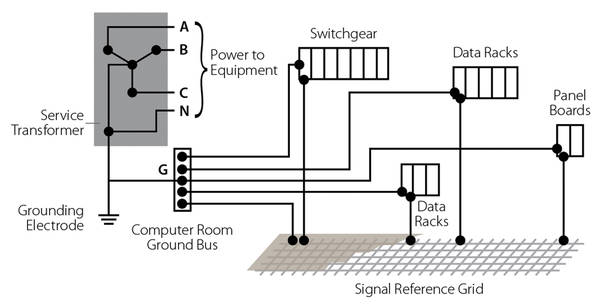
Electrical systems do not need to be grounded to function. In fact, not all electrical systems are grounded. But when discussing electrical systems, usually the voltages are with respect to ground. The term “ground” represents a reference point—or a zero potential point—to which all other voltages refer. A zero reference voltage is critical for proper operation of electronic equipment. Unfortunately, the least amount of attention is focused on grounding, bonding, and wiring. Typical wiring and grounding problems include:

  • Faulty, loose, or resistive connections that result in heating, and potential arcing and burning of the insulation
  • Missing equipment grounds that create situations where there is no effective return path for ground-fault current
  • Power supply conduits insulated from computer cabinets with PVC conduit fittings
  • Conduit runs that end before reaching the equipment with a conductor running exposed the remaining distance
  • Green, insulated grounding conductors that are run separately from the phase conductors.

Another common grounding problem is using an isolated ground with the idea of obtaining a clean ground. Isolated grounds are typically misunderstood and misapplied because they are not actually isolated, but rather insulated, thereby eliminating parallel return paths. Installation of an isolated ground conductor is governed by NEC Article 250.146(D) Isolated Ground Receptacles and is used to reduce electrical noise on the grounding circuit by purposely insulating the receptacle from the mounting means. The receptacle grounding terminal is instead connected to an insulated equipment grounding conductor run with the circuit conductors, and is permitted to pass through one or more panelboards without connection to the panelboard grounding terminal bar. This isolated ground conductor terminates at the source of the separately derived system or service. The conductor is not isolated from the electrical grounding system.

Sometimes isolated or dedicated grounds are recommended by equipment manufacturers. These recommendations can compromise the safety and performance of the equipment, are dangerous, violate the NEC, and are unlikely to solve power quality problems.

Safety and equipment performance depend on the proper selection and installation of the power and electronic equipment grounding and bonding system. In all circumstances, the equipment and grounding system must comply with the NEC and local installation codes. A solidly grounded ac system with insulated equipment grounding conductors should be used to feed electronic loads. All metal parts of equipment enclosures, raceways, and grounding conductors are to be effectively and permanently bonded to each other and to the power system grounding electrode system at the service entrance and at each separately derived system.

Publicado em Artigos Tecnicos | Com a tag , , , , , | Deixe um comentário

Institute Kicks Off Effort to Develop National BIM Guideline for Owners

Fonte (Source): National Institute of Building Sciences

Acesse aqui a matéria em sua fonte.

The National Institute of Building Sciences (NIBS) is kicking off development of a new guideline to help building owners and their design teams utilize building information modeling (BIM) during the building design, construction and operations process and to better support owners’ performance requirements.

The National BIM Guideline for Owners, to be developed under the auspices of NIBS, The American Institute of Architects (AIA), Building Owners and Managers Association International (BOMA), International Facility Management Association (IFMA) and ASHRAE, will provide uniformity in the delivery of BIM projects to federal, state and local government building owners, as well as institutional and commercial building owners.

The guideline is intended for adoption by the building owner to provide a documented process and procedure for the owner’s design team to follow in order to produce a standard set of BIM documents during the design and construction of the facility, and for maintenance and operations of the facility upon handoff. The new guideline will be based on the foreign, federal, state and local BIM guides that currently exist, but geared to a generic facility with uniform requirements for use by a variety of government, institutional and commercial building owners. It will reference a range of documents and practices, including those contained within the National BIM Standard-United States® developed by one of NIBS’ own councils, the buildingSMART alliance®.

The recently established development committee consists of about a dozen BIM experts representing important stakeholder groups, including building owners, architects, engineers, constructors and facility managers. The first task of the committee is to review the relevant and applicable BIM guides currently available, and then proceed to developing the guideline itself. An advisory committee composed of federal, state and local government representatives who developed existing BIM guides will review the effort and provide input on an on-going basis. Once the guideline is complete, the development committee will submit the draft guideline to the buildingSMART alliance membership for review and input. The final guideline will then be submitted to the appropriate standards developing organization (SDO) to go through its consensus process for joint publication as an industry standard.

The goal is for federal, state and local governments and other institutional and commercial building owners to adopt the National BIM Guideline for Owners as the standard procedure for their design/BIM teams to follow, helping building owners unlock the value and opportunity to utilize BIM across the life cycle of a building. Establishing criteria, specifications and expectations in the design and construction process will help owners capture the full value of investing in BIM, while providing a uniform approach for institutional and commercial building owners to achieve consistent BIM requirements for their facilities.

Publicado em Artigos Diversos | Com a tag , , , , , | Deixe um comentário

Integração regional no setor de energia eólica é realidade

Fonte: Ambiente Energia

Acesse aqui a matéria em sua fonte.

A integração regional no setor de energiaeólica é uma tendência irreversível. A previsão é do superintendente de Operações no Exterior da Eletrobras, Pedro Luiz de Oliveira Jatobá. No entanto, o que não se pode precisar ainda, segundo ele, é em que velocidade isso se dará, porque dependerá da capacidade política dos governos se articularem em ter um planejamento estratégico regional.

No Brasil, de acordo com a Jatobá, a política pública voltada para esse tipo de fonte de energia é um caso de sucesso mundial. “Os leilões de reserva que estimulam o mercado para a compra desta energia e a estrutura de financiamento desenhada para os investidores para este tipo de aquisição foram elementos fundamentais para este sucesso”, disse.

Para o superintendente, olhando para o futuro, outro fator de sucesso está na integração do Brasil com países vizinhos. “Pelo volume do mercado brasileiro, pela estruturação da cadeia nacional, existe uma possibilidade real da cadeia produtiva brasileira fornecer para outros países latino-americanos. Com o processo de integração que vai permitir expandir a fronteira eólica nos outros países, surgirão mercados para o Brasil exportar neste momento, que é um momento importante para a exportação brasileira”, afirmou.

Jatobá disse que o setor de energia eólica do Uruguai já tem a participação de investidores brasileiros que levaram para lá equipamentos e projetos desenvolvidos no Brasil. “O Brasil hoje é um polo de exportação de equipamentos de tecnologia eólica”. Segundo ele, a importação permitirá que outros países possam desenvolver os seus potenciais eólicos, que ainda estão limitados pelos mercados nacionais. “Isso dará espaço para que os fabricantes brasileiros exportem seus equipamentos para o desenvolvimento desses potenciais em outros países”.

O presidente da Associação Uruguaia de Energia Elétrica (AUdee), Fernando Schaich, estimou que em 2017 o Uruguai poderá se tornar o país com maior quantidade de energia eólica. Este ano 35% da energia consumida por lá já é dessa fonte. Ele disse que em 2010, após um acordo multipartidário, a energia renovável passou a ser uma política de Estado. “Foi acertada por todos os partidos que tinham, naquela momento, participação no Parlamento. Independentemente de qual partido esteja no governo, essa política vai se manter no longo prazo”.

O diretor de vendas da Vulkan do Brasil, fabricante de freios de rotor e de aerogerador, Tiago Bedani, concorda que a integração é o caminho da indústria eólica, mas, cauteloso, acrescentou que a cadeira produtiva precisa de mais investimentos. No Brasil, a empresa do grupo alemão, instalada no interior de São Paulo, atingiu 90% de conteúdo local. “Desde de 2008 que a gente procura a certificação local pelo Banco Nacional de Desenvolvimento Econômico e Social (BNDES). Hoje, pelo câmbio nos favorece entrar no mercado exterior”, disse.

Financiamento

Para o diretor-presidente da Renova Energia, Mathias Becker, a integração teria que passar também pelo sistema de financiamento. Segundo ele, no Brasil, essa parte está restrita ao BNDES. E entende que é preciso buscar outros caminhos. “Nós, brasileiros, estamos habituados ao BNDES. Todo mundo sabe da situação das contas do país, como o BNDES vai se portar no futuro e quais são os desembolsos que vão continuar acontecendo. Acho que esse é um grande aprendizado que temos que trazer de fora”, disse.

O vice-presidente corporativo de energia do Banco de Desenvolvimento da América Latina, Hamilton Moss, informou que atualmente a entidade trabalha com uma carteira em torno de US$ 20 bilhões, e 2% são para projetos de transmissão de energia eólica. Segundo ele, o Brasil, no mercado da regional, tem participação importante, e o Uruguai, mais recentemente, está crescendo acompanhado do Chile.

“São os projetos que estão chegando, e vamos atendendo às demandas. Na nossa meta, a gente fez um planejamento estratégico mais recente, a parte de energia renováveis é importantíssima solar e eólica. Vamos investir cada vez mais nisso, e eólica, evidentemente, vai ter um privilégio pelo tamanho do que já existe”. Moss informou que a Eletrobras é um cliente importante da entidade que, nos empréstimos soberanos, trabalha, geralmente, com estados e municípios, como ocorreu nas obras do Estádio Jornalista Mário Filho, o Maracanã, e em rodovias.

Os executivos participaram do Brazil Windpower 2015, encontro que reuniu investidores e especialistas do setor eólico, no Centro de Convenções SulAmérica, na cidade do Rio de Janeiro.

Fonte: Agência Brasil

Conteúdos Relacionados:

YARPP

Publicado em Brasil, Eficiência Energética, Sustentabilidade | Com a tag , , , , | Deixe um comentário